
Chapter 14: Quantum Gravity and Unified Field Theory
The century-old divide between quantum mechanics and general relativity closes here on a single premise: if the graviton is a vibrational mode of a 2D field rather than a particle on a fixed background, then spacetime is not the stage for gravity—it is what gravity's field dynamics produce.
Chapter Contents
14.1 Quantum Gravity: Foundations and Foam Integration
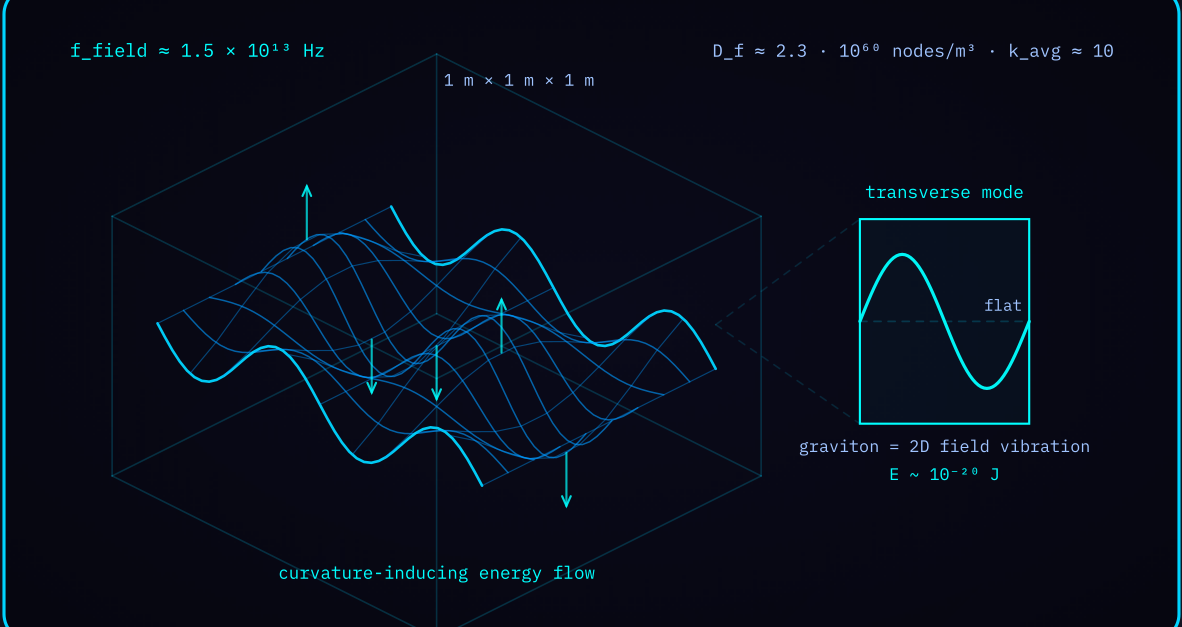
In Dimensional Relativity, quantum gravity unifies quantum mechanics and general relativity through quantum foam's two-dimensional energy fields.
ffield ≈ Efield / h ≈ 1.5 × 10¹³ Hz
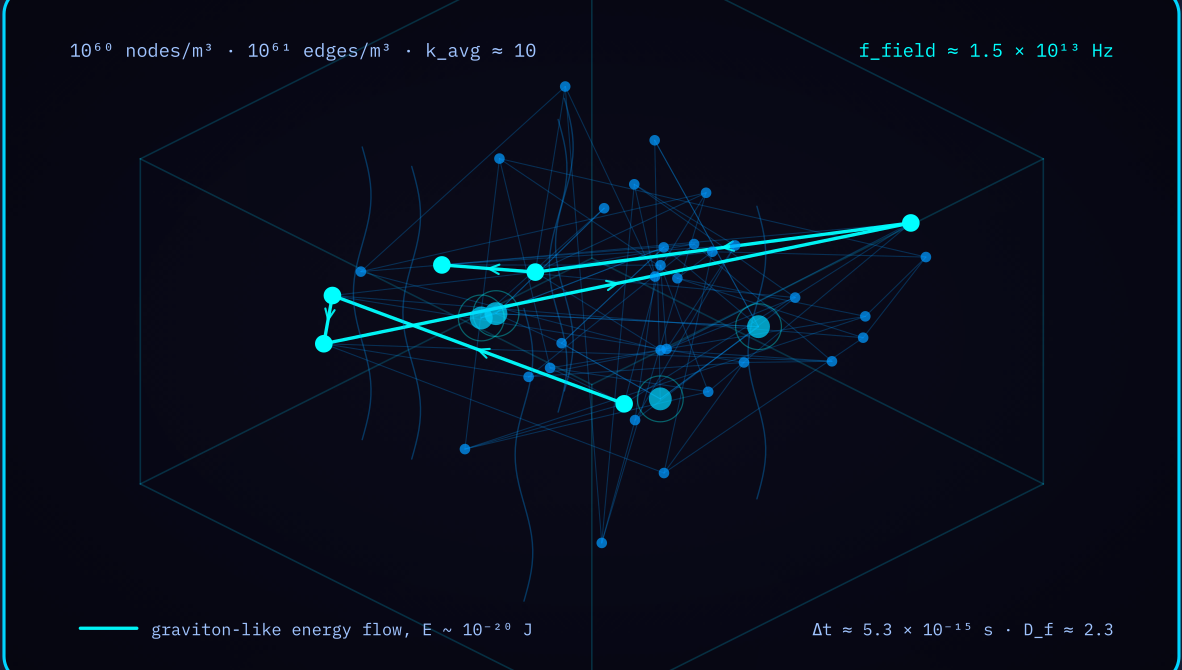
These fields, embedded in the foam's fractal network (Df ≈ 2.3) with 1060 nodes and 1061 edges per m³ (kavg ≈ 10), mediate gravitational interactions at Planck scales (10-35 m). The stress-energy tensor incorporates foam contributions directly.
Gμν = (8πG / c4) Tμν
The model posits quantum gravity as a foam-mediated phenomenon, with gravitons emerging as vibrational modes of 2D fields. This approach unifies Einstein's field equations with quantum mechanics, treating spacetime as an emergent property of foam field dynamics rather than a fundamental background.
Historical Context
Detection Method — Graviton-Like Signatures
A graphene-based detector could measure ffield fluctuations in vacuum systems, capturing graviton-like signatures at 1.5 × 10¹³ Hz via high-resolution spectroscopy.
Mobility ~200,000 cm²/V·s · detection 1.5 × 10¹³ Hz · graviton energy ~10-20 J · spacetime resolution 10-35 m
14.2 Quantum Foam as Gravity Substrate
Quantum foam serves as the substrate for quantum gravity, its 2D fields oscillating at ffield mediating graviton-like interactions. The fractal structure enhances field density roughly tenfold at Planck scales, with virtual particle–antiparticle pairs (lifetime Δt ≈ 5.3 × 10⁻¹⁵ s) contributing to gravitational effects.
The high-connectivity network (kavg ≈ 10) channels gravitational interactions, supporting spacetime quantization through spin network-like structures that align with loop quantum gravity while remaining compatible with string theory's graviton modes.
Planck Epoch Dynamics
Foam-driven quantum gravity during the Planck epoch (~10-43 s post-Big Bang) shaped spacetime structure, creating signatures detectable in:
- CMB anisotropies from quantum gravity fluctuations
- Primordial gravitational wave spectra
- Large-scale structure correlations
- Black hole entropy and information paradox resolution
14.3 Frequency in Quantum Gravity Dynamics
Frequency unifies quantum gravity with all other phenomena in Dimensional Relativity, revealing a universal 2D field substrate.
| Phenomenon | Symbol | Frequency |
|---|---|---|
| Quantum gravity | ffield | ≈ 1.5 × 10¹³ Hz |
| Quantum foam | ffield | ≈ 1.5 × 10¹³ Hz |
| Dark energy | ffield | ≈ 1.5 × 10¹³ Hz |
| Holographic encoding | ffield | ≈ 1.5 × 10¹³ Hz |
| Particle interactions | fparticle | ≈ 1.5 × 10¹⁵ Hz |
This alignment demonstrates that ffield drives graviton-like interactions, while higher frequencies govern particle dynamics within the unified field framework.
14.4 Network Theory and Quantum Gravity Dynamics
Quantum gravity operates as a dynamic process within the foam's computational network, where high-connectivity nodes (kavg ≈ 10) channel gravitational interactions through scale-free topology. Gravitons, as vibrational modes, contribute to spacetime curvature through network-mediated field dynamics.
14.5 Space/Time and Quantum Gravity Interactions
Spacetime emerges from the foam's 2D field interactions, with quantum gravity shaping curvature through foam-mediated graviton dynamics. The fractal structure enhances gravitational effects roughly tenfold at Planck scales, supporting spacetime quantization while remaining compatible with general relativity at macroscopic scales.
Gμν = (8πG / c4) Tμν
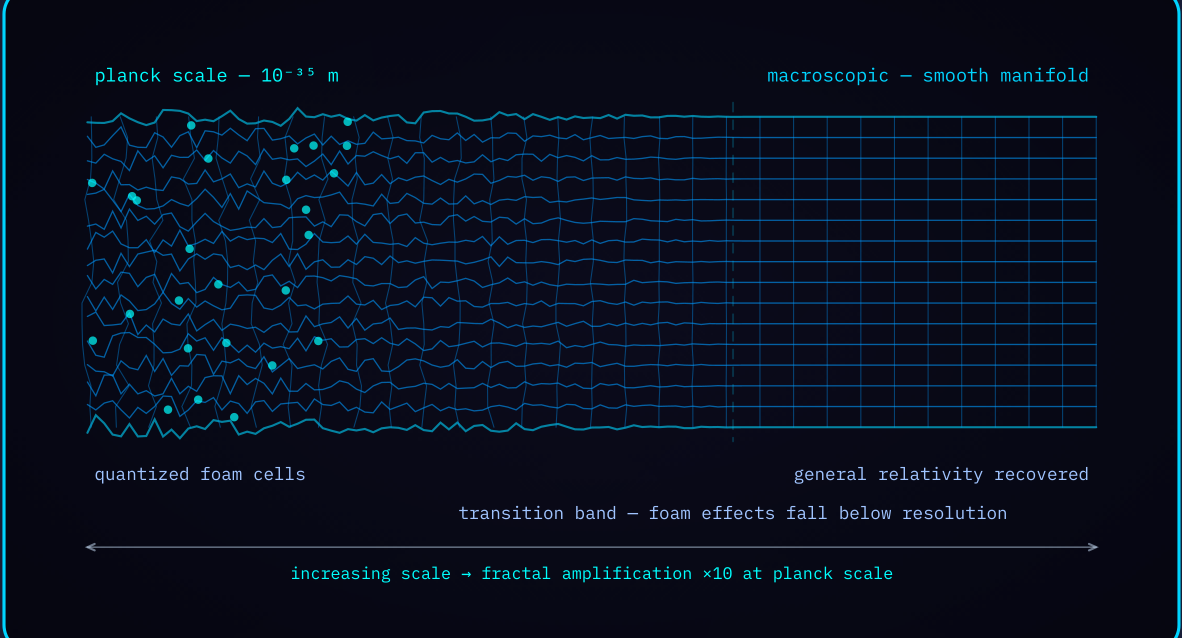
This model positions spacetime as a holographic projection of foam-mediated graviton interactions, unifying quantum and macroscopic scales through the universal frequency substrate.
14.6 Engineering Quantum Gravity Technologies
Gravitational modulators
Tuning ffield to alter curvature; controlled graviton-like interactions enabling warp drive.
Chapter 18
Quantum gravity sensors
Graphene detection of foam–graviton interaction and spacetime fluctuation.
Prototype testing phase
Energy extractors
Harnessing foam-mediated gravitational energy and curvature effects for power.
Chapter 19
Graviton processors
Computing systems using graviton-like states for information processing.
Chapter 20
Cosmological probes
Investigating Planck epoch structure through CMB and gravity wave detection.
Primordial gravity waves
Unified field engines
Technologies built on quantum gravity's unification of the fundamental forces.
Next-generation systems
Chapter Summary
- Quantum gravity unification: foam-mediated gravitons at ffield ≈ 1.5 × 10¹³ Hz bridge quantum and gravitational scales
- Spacetime emergence: spacetime as an emergent property of 2D field dynamics rather than a fundamental background
- Network topology: high-connectivity foam networks enabling gravitational interaction through scale-free architecture
- Frequency universality: a universal field substrate connecting quantum gravity to all other phenomena
- Planck epoch physics: quantum gravity effects during early universe formation
- Technological applications: gravitational modulators, energy extractors, and unified field engines
Unifying quantum mechanics and general relativity through foam dynamics provides a foundation for understanding spacetime at its most fundamental level, while enabling technologies based on controlled gravitational effects and unified field interactions.
References
- Einstein, A. (1915). General relativity and spacetime curvature.
- Wheeler, J. (1955). Quantum foam and geometrodynamics.
- Ashtekar, A. (1986). New variables for classical and quantum gravity.
- Rovelli, C. (2004). Quantum gravity and the spin network formalism.
- Foster, J. (2025). Dimensional Relativity framework.