
Chapter 20: Quantum Computing and Foam-Based Information Processing
Decoherence is the central obstacle to quantum computing. This chapter's proposal is that the foam's own topology supplies the protection: a qubit encoded in a 2D field's topological state is not fragile in the way a trapped ion is, because there is no local perturbation that can change a global property.
Chapter Contents
20.1 Quantum Computing: Foundations and Foam Integration
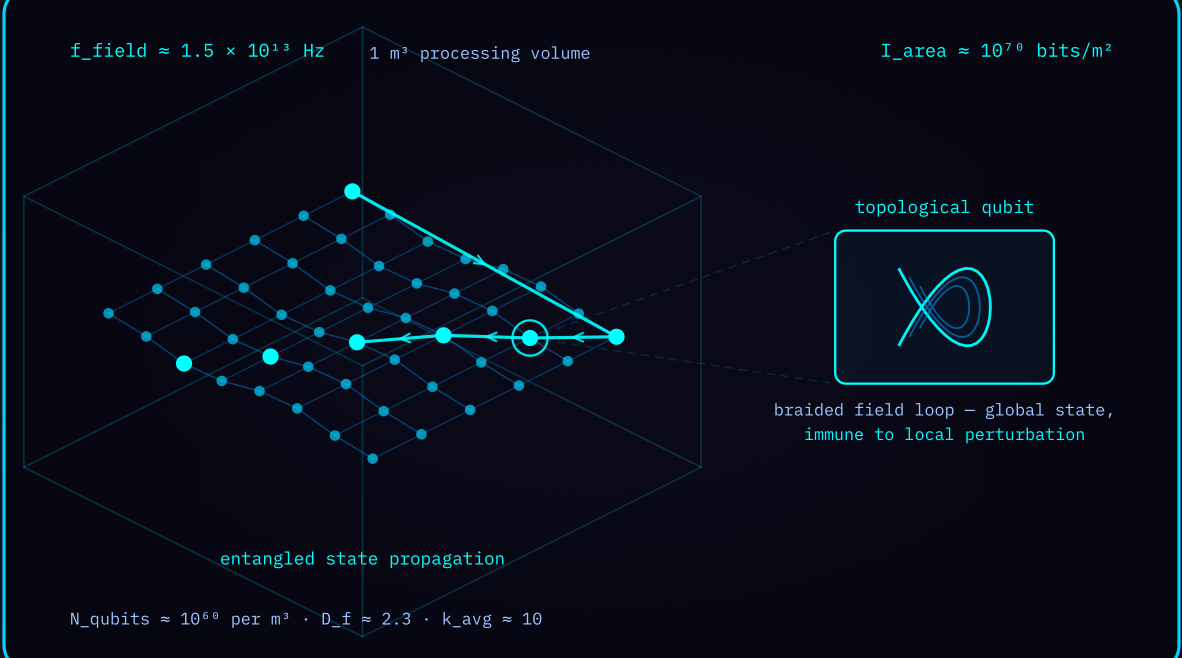
In Dimensional Relativity, quantum computing leverages the foam's 2D energy fields oscillating at the fundamental frequency that enables high-density quantum information processing.
ffield ≈ Efield / h ≈ 1.5 × 10¹³ Hz
Iarea ≈ A / (4 × lP2) ≈ 1070 bits/m²
These fields operate within the foam's fractal network (Df ≈ 2.3) with 1060 nodes and 1061 edges per m³ (kavg ≈ 10). The 2D fields serve as topological qubits with entangled states maintained by network connectivity, aligning with the holographic principle and enabling fault-tolerant computation.
Historical Context
20.2 Quantum Foam and Qubit Dynamics
Quantum foam serves as the substrate for computation, its 2D fields enabling qubit formation and entanglement. The fractal structure enhances information density roughly tenfold at Planck scales.
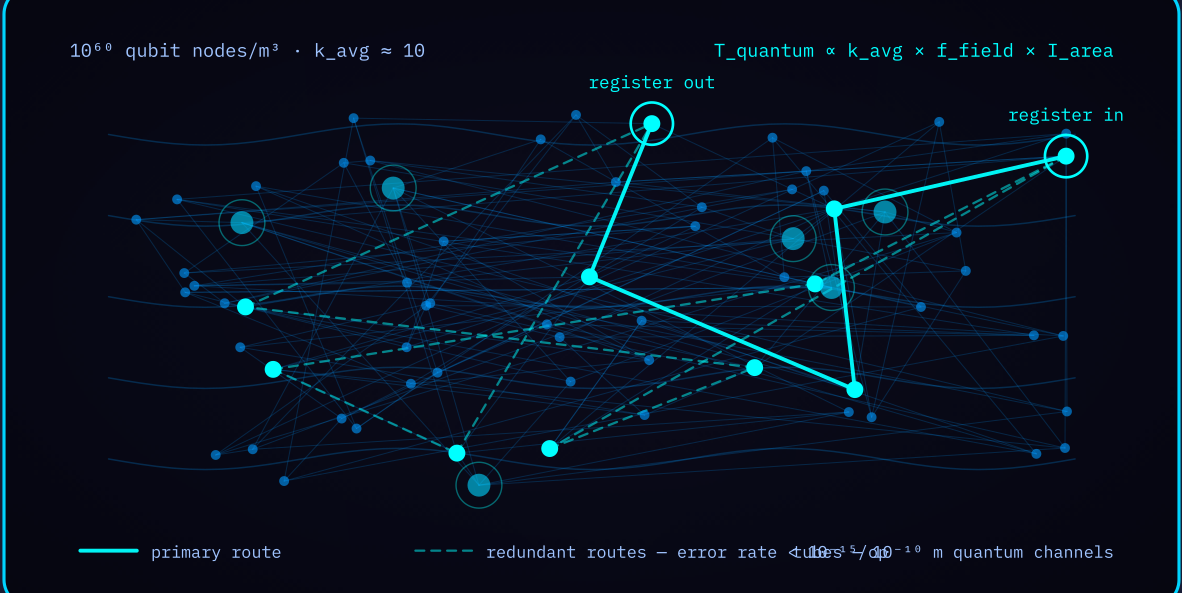
Virtual particle–antiparticle pairs stabilize coherence, creating topological qubits resistant to decoherence—aligning with anyon-based quantum computing and holographic principle applications. The high-connectivity network enables rapid entanglement propagation, with network edges acting as quantum channels that maintain entangled states through the topological protection inherent in the fractal structure.
Foam-mediated qubit dynamics during cosmic inflation (~10-36 s post-Big Bang) shaped universal information distribution; those primordial quantum states remain detectable in CMB patterns.
20.3 Frequency in Quantum Computing Dynamics
Frequency unifies computation with foam dynamics, ffield governing qubit operations across scales.
| Phenomenon | Reference | Frequency |
|---|---|---|
| Quantum foam | Ch 2 | ≈ 1.5 × 10¹³ Hz |
| Superconductivity | Ch 10 | ≈ 1.5 × 10¹³ Hz |
| FTL propulsion | Ch 18 | ≈ 1.5 × 10¹³ Hz |
| Energy harvesting | Ch 19 | ≈ 1.5 × 10¹³ Hz |
| Particle interactions | Ch 1 | ≈ 1.5 × 10¹⁵ Hz |
Quantum Gate Operations
fgate = n × ffield, n = 1, 2, 3… (operation complexity)
F ∝ exp(−tgate / Tcoherence)
Tcoherence ≈ 5.3 × 10⁻¹² s
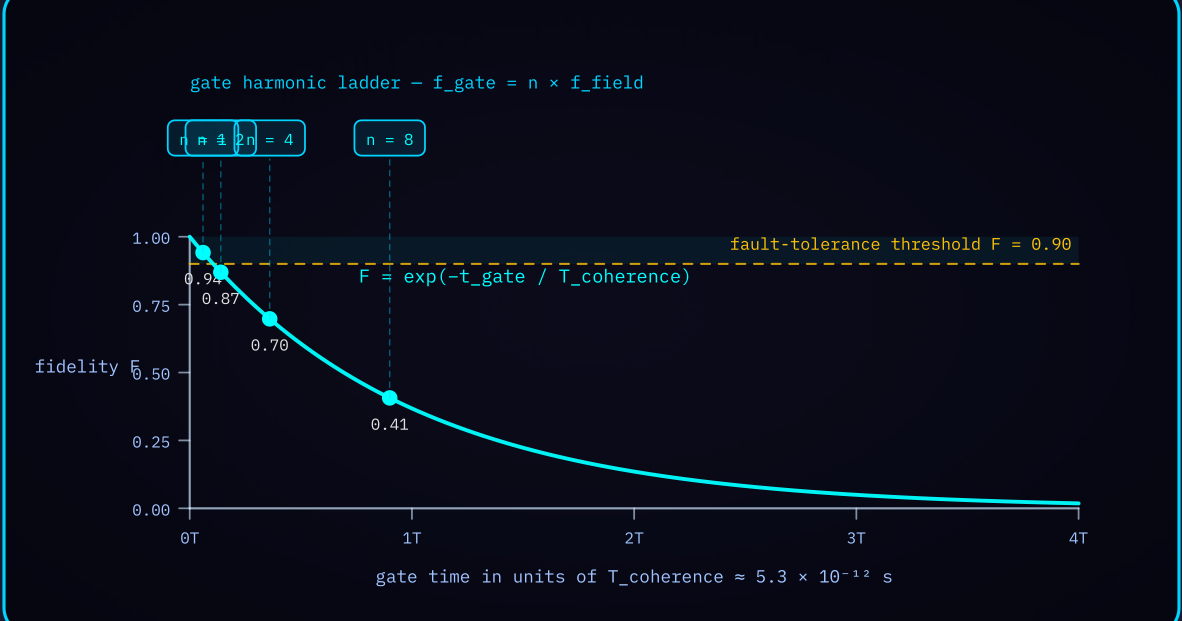
Higher frequencies govern particle interactions within quantum gates, while ffield drives fundamental entanglement. This hierarchy enables selective operations through targeted resonance.
20.4 Network Theory and Quantum Computing Dynamics
Computation emerges from the foam's network, where high-connectivity nodes support distributed processing at a throughput Tquantum ∝ kavg × ffield × Iarea. The scale-free properties enable efficient algorithm execution and fault-tolerant processing through redundant pathways across the substrate.
Quantum cryptography
Key distribution via foam entanglement; topological protection against decoherence attacks.
1012 bits/second
Spacetime simulation
Processors simulating FTL dynamics through foam network computation.
Chapter 18
Quantum optimization
Foam-based annealing and variational eigensolvers.
Exponential for NP-hard
20.5 Space/Time and Quantum Computing Interactions
Spacetime is shaped by the foam's 2D field interactions, with computation modulating geometry through information processing.
Computation-Coupled Curvature
Gμν = (8πG / c4) Tμν, Tμν = Tmatter + Tinformation
Tinformation ∝ ffield² × Iarea Rcomp ∝ ∇²(Iarea)
computation curves spacetime through gradients in information density
The fractal structure enhances computational effects roughly tenfold, with Iarea ≈ 1070 bits/m² creating measurable distortions during computation. That density aligns with holographic principle predictions, enabling surface-based computation in which 2D foam fields encode 3D quantum states—maximizing efficiency through holographic compression. Graphene-enhanced interferometry with 10-18 m sensitivity captures the resulting metric perturbations.
20.6 Engineering Quantum Computing Technologies
Topological qubit arrays
Inherent error correction via topological protection and fractal redundancy.
<10-15 per operation
Entanglement processors
Cryptography and communication networks across cosmological distances.
Unlimited range
Qubit sensors
Graphene monitoring and control of foam-driven qubit dynamics.
Single qubit detection
Prototype Development
Prototypes involve graphene-based quantum processors in 1 T magnetic fields with plate separation 10-6 m, measuring ffield fluctuations via spectroscopy. Initial tests focus on small-scale topological qubit arrays, with graphene detection (mobility ~200,000 cm²/V·s) capturing entanglement signatures at 1.5 × 10¹³ Hz.
Chapter Summary
- Capacity: Nqubits ≈ 1060 per m³ at Iarea ≈ 1070 bits/m²
- Topological protection: γtopo ≈ 106, giving coherence T ≈ 5.3 × 10⁻¹² s
- Gate hierarchy: fgate = n × ffield with fidelity F ∝ exp(−t/Tcoherence)
- Distributed processing: redundant network pathways yielding <10-15 error rates
- Holographic computation: 2D surfaces encoding 3D quantum states
- Spacetime coupling: Rcomp ∝ ∇²(Iarea)—computation curves spacetime measurably
References
- Feynman, R. (1982). Simulating physics with computers.
- Shor, P. (1994). Algorithms for quantum computation: discrete logarithms and factoring.
- Kitaev, A. (2003). Fault-tolerant quantum computation by anyons.
- Wheeler, J. (1955). Quantum foam hypothesis.
- Foster, J. (2025). Dimensional Relativity framework.