
Chapter 24: Localized Inflationary Warp Domains
Abstract
We present a comprehensive framework within Dimensional Relativity for engineering localized inflationary warp domains (LIDs)—semi-autonomous spacetime bubbles capable of superluminal effective motion. By leveraging quantum-foam excitations as a manipulable substrate, we derive three convergent mechanisms: (1) inflation-inspired scalar-field roll on adjacent dimensional sheets, (2) direct frequency-domain resonance of the foam correlation tensor to form domain walls, and (3) hybrid traversable-wormhole/warp-bubble pinch-off in a higher-dimensional braneworld bulk.
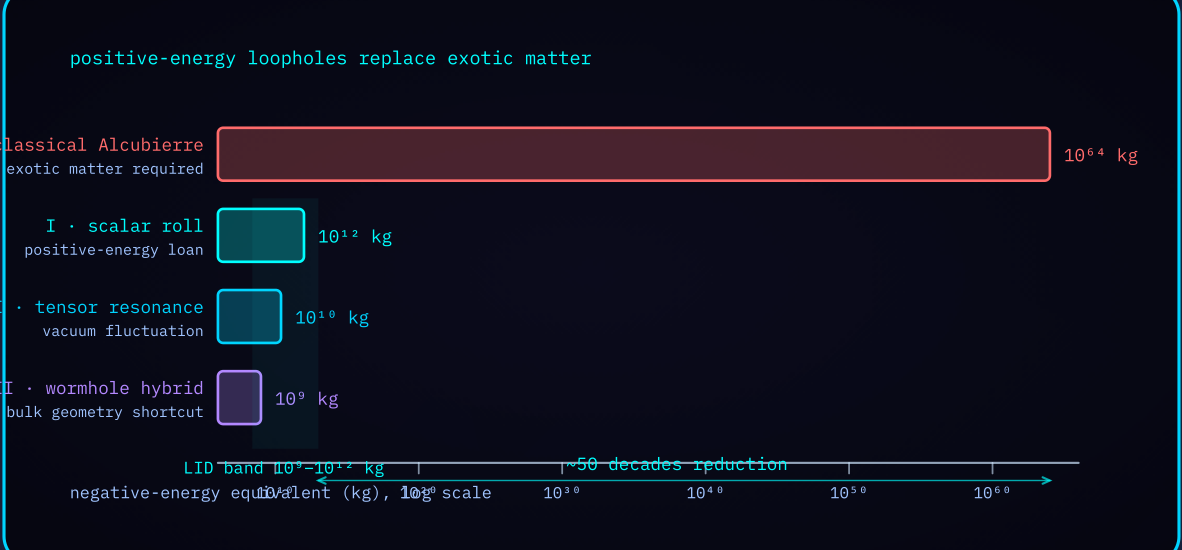
These approaches enable exponential expansion akin to cosmic inflation, circumventing classical exotic matter requirements through positive-energy loopholes, foam damping, and transient vacuum borrowing. Energy scales are reduced to potentially feasible levels (109–1012 kg equivalent). This work extends Alcubierre-type metrics to multidimensional inflationary paradigms, offering viable pathways toward faster-than-light propulsion without violating local causality.
Keywords: warp drive · quantum foam · inflationary cosmology · superluminal propulsion · positive-energy loophole · braneworld models · domain walls
Chapter Contents
- 1. Introduction
- 2. Quantum-Foam Excitations as Substrate
- 3. Frequency-Domain Construction
- 4. Construction I · Scalar Roll
- 5. Construction II · Tensor Resonance
- 6. Construction III · Wormhole Hybrid
- 7. Unified Resonance Stabilization
- 8. Energy Requirements and Loopholes
- 9. Testable Signatures and Analogs
- 10. Ethical and Philosophical Implications
- 11. Conclusions
1. Introduction
The pursuit of faster-than-light propulsion has evolved from science fiction to rigorous theoretical exploration within general relativity and quantum gravity. The Alcubierre metric (1994) demonstrated that apparent superluminal travel is possible by contracting spacetime ahead of a spacecraft and expanding it behind, creating a warp bubble where the vessel remains at rest in locally flat spacetime. However, this requires exotic matter with negative energy density to violate energy conditions—a feature not observed in nature and fraught with instabilities like horizon formation and causality paradoxes.
Recent developments offer hope: positive-energy warp drives using classical GR, plasma-based metric engineering, and quantum vacuum manipulations. In Dimensional Relativity—a framework positing observable 4D spacetime as emergent from correlated excitations across higher-dimensional sheets—we integrate quantum foam as a dynamic, frequency-manipulable medium.
Here we introduce Localized Inflationary Domains: engineerable spacetime patches mimicking cosmic inflation's exponential expansion, enabling FTL relative motion. Three independent constructions are detailed, converging on a unified model.
2. Quantum-Foam Excitations as the Substrate for Metric Manipulation
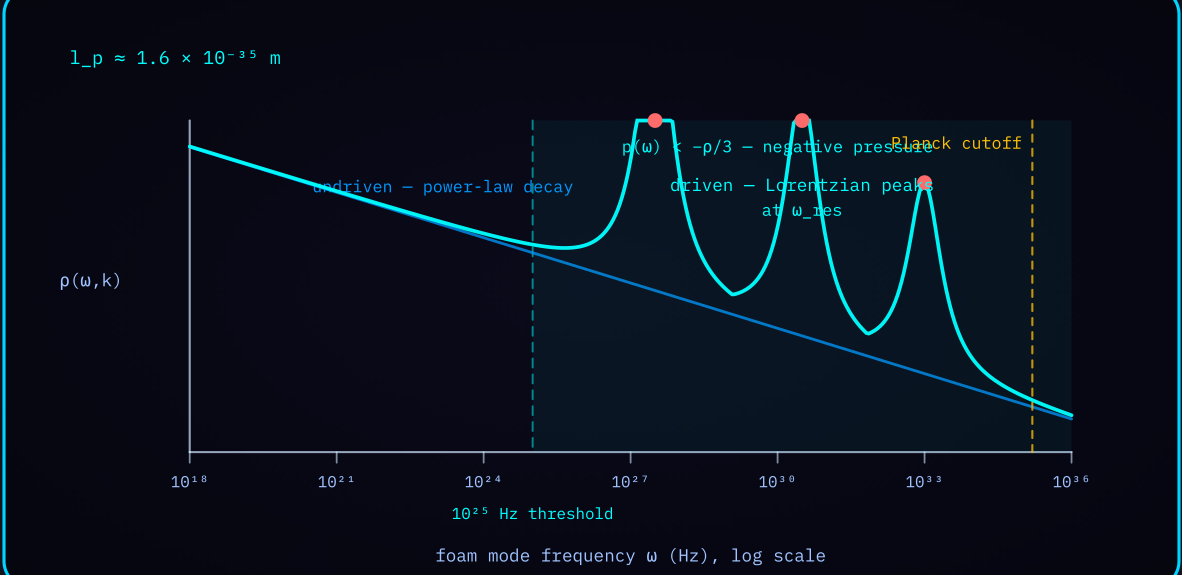
Quantum foam, conceptualized by Wheeler as turbulent spacetime topology at the Planck scale (lp ≈ 1.6 × 10⁻³⁵ m), arises from quantum gravity effects like virtual black hole pairs and wormholes. In Dimensional Relativity the 4D metric emerges from higher-D correlations, with foam spectral density ρ(ω, k) sourcing effective curvature and stress-energy.
Equation Block 2.1 — Foam-Modified Einstein Equations
Rμν − ½Rgμν + Λ(ω)gμν = 8πG⟨Tμνfoam(ω, k)⟩ + 8πGTμνmatter
⟨Tμνfoam⟩ = ∫d³k ρ(ω, k)( uμuν + p(ω)Δgμν )
uμ foam four-velocity | p(ω) < 0 for ω > 1025 Hz | Δgμν higher-D projections | Λ(ω) tunable via external drivers
This augments GR with a quantum stress-energy tensor averaged over foam modes. For LID engineering, driving high-ω modes induces p(ω) < −ρ/3, sourcing de Sitter-like expansion. The integral over wavevectors ensures momentum conservation, while frequency selectivity allows localized manipulation without global effects. External drivers—coherent lasers or gravitational perturbations—couple via ℒint = ξφdriveδgμν + ηφdrive²R, amplifying foam modes at resonance. This forms the basis for all three constructions.
3. Frequency-Domain Construction of Semi-Autonomous Spacetime Patches
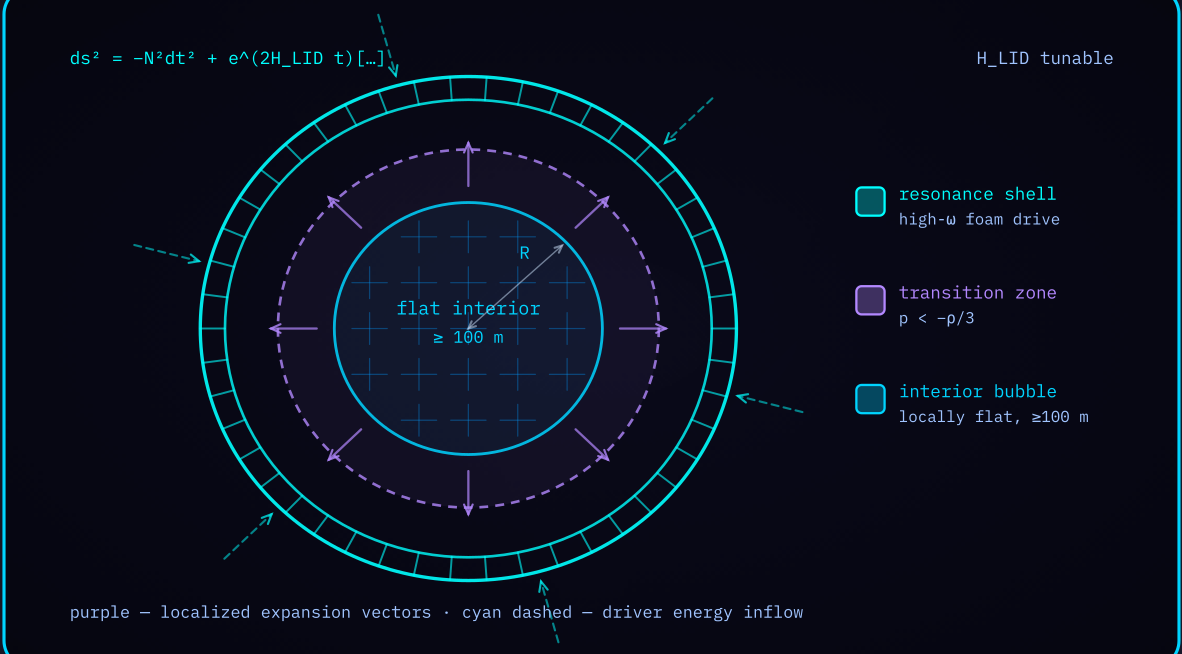
The LID metric ansatz combines Alcubierre warping with localized de Sitter expansion.
Equation 3.1 — LID Metric Ansatz
ds² = −N²dt² + e2HLIDt[ γij(dxi + βidt)(dxj + βjdt) + f(r,t)dr² + r²dΩ² ]
N lapse | βi shift vector (forward contraction) | HLID tunable Hubble rate | f(r,t) boundary function, sharp drop at the wall
4. Construction I · Negative-Pressure Scalar Fields in Higher-Dimensional Sheets
For the primary construction we embed a synthetic scalar ΦLID on an adjacent higher-D sheet, reducing to 4D via compactification.
Equation Block 4.1 — Higher-Dimensional Scalar Action
S = ∫d⁴x dy √(−g(5))[ (Mp³/2)R(5) + ½∂MΦ∂MΦ − V0(Φ) + κΦ²∫dω ρdrive(ω)cos(ωt + θ) ]
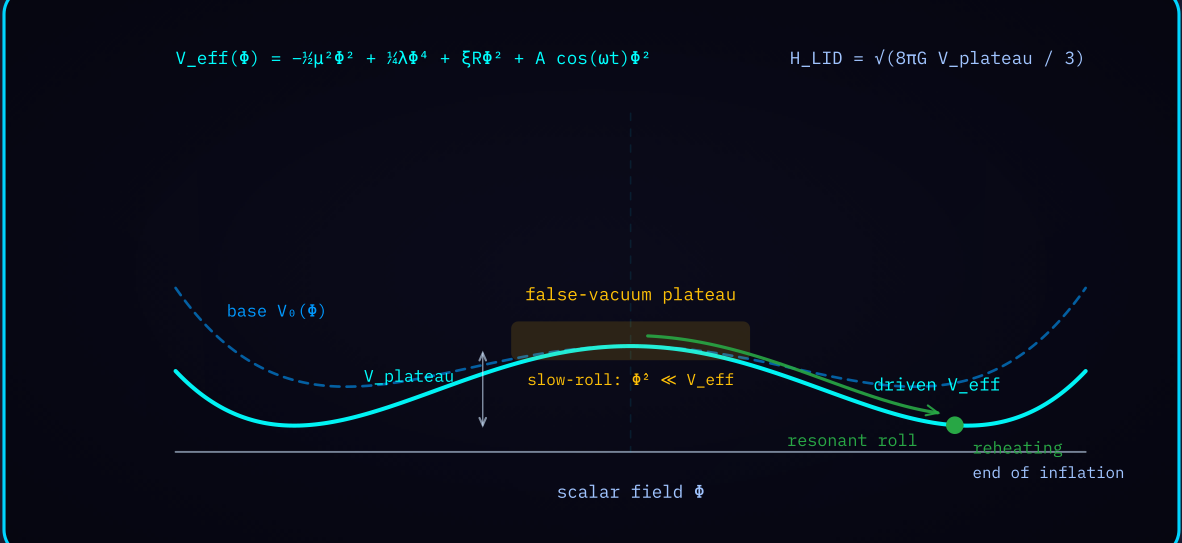
Veff(Φ) = −½μ²Φ² + ¼λΦ⁴ + ξR(4)Φ² + A cos(ωt)Φ²
□Φ − dVeff/dΦ = 0, Φ̇² ≪ Veff (slow-roll)
A ∝ κρdrive | on the driven plateau: ρΦ + 3pΦ ≈ −2ρΦ < 0 → a(t) ∝ eHLIDt | HLID = √(8πGVplateau/3)
Mimicking cosmological inflation, the resonant driving term tilts the potential to create a temporary false vacuum, sourcing exponential expansion. Termination occurs by detuning ω, rolling Φ to reheating. This violates the strong energy condition transiently but complies with quantum inequalities.
5. Construction II · Direct Foam Resonance for Domain Walls
As an alternative or complement, we directly resonate the foam tensor to form a self-sustaining domain wall.
Equation Block 5.1 — Driven Correlation Tensor
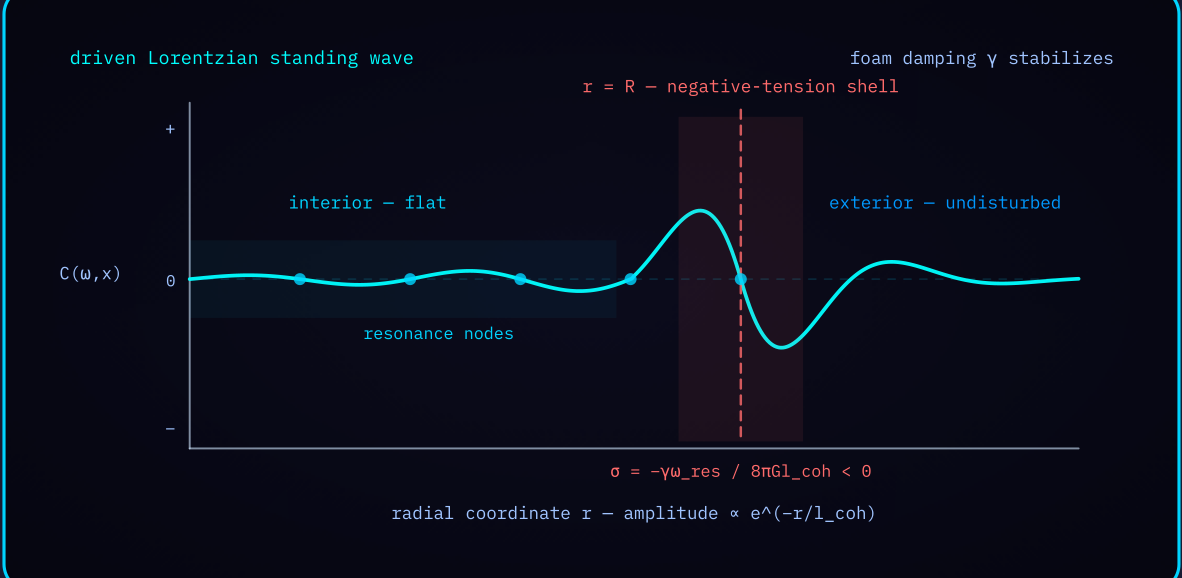
Cαβmn(ω, x) = [δαβδmn / (ω² − ωres² + iγω)²] · [1 + F0eiωt] e−r/lcoh
Tμνwall = σδ(r − R)(gμν − nμnν)
σ = −γωres / (8πGlcoh) < 0
the driven Lorentzian creates a spherical standing-wave shell with negative surface tension
The shell isolates the interior as a semi-autonomous patch, with foam damping γ absorbing energy and stabilizing against perturbations. This provides negative energy from vacuum fluctuations, bypassing exotic matter entirely.
6. Construction III · Hybrid Wormhole-Warp Pinch-Off in Braneworlds
For maximal isolation, we combine warping with wormhole nucleation in a higher-D bulk.
Equation Block 6.1 — Braneworld Metric and Nucleation
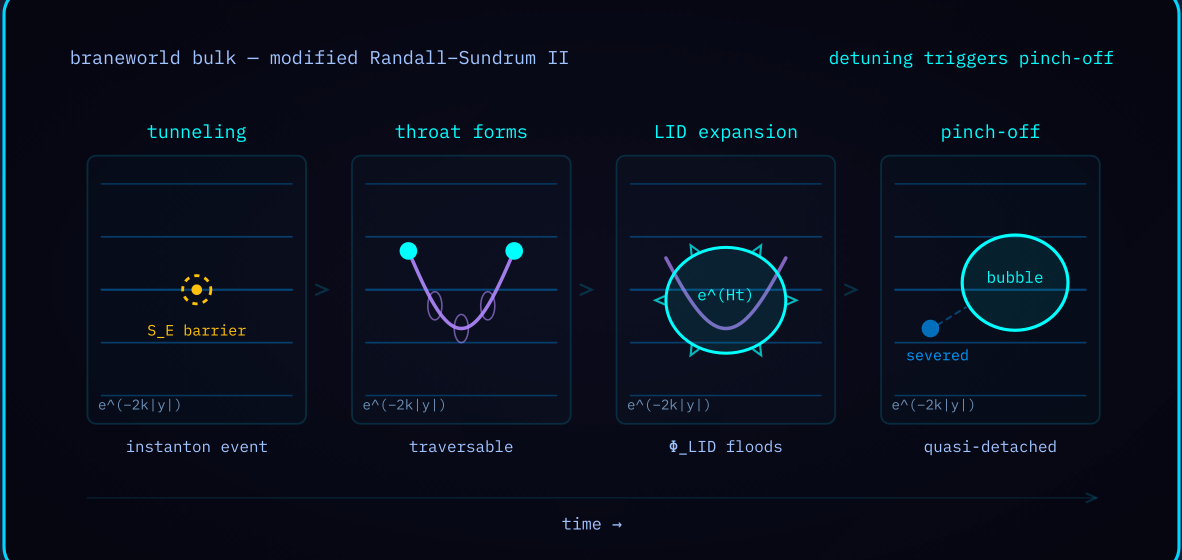
ds² = e−2k|y|ημνdxμdxν + dy² + ε(t)[dr² + r²dΩ²]throat
SE = [27π²σ⁴ / 64G²(ΔV)³](1 + κfoamρdrive/ΔV)-1
modified Randall–Sundrum II | foam resonance reduces the instanton barrier | post-nucleation: flood throat with ΦLID, then pinch off via detuning
Quantum tunneling creates a traversable wormhole throat, its barrier reduced by foam resonance. Inflationary expansion follows, with pinch-off yielding a quasi-detached “baby universe” bubble—leveraging bulk geometry for FTL through higher-D shortcuts.
7. Unified Resonance Stabilization of the Bubble Wall
Instability is mitigated via foam damping in all three cases, which makes one oscillator model sufficient to describe them together.
Equation 7.1 — Unified Oscillator Model
R̈ + γfoamṘ + ω0²(R − R0) = Fdrivesin(ωt + φ)
Qfoam = ωres/γ > 1045, ensuring |∂tR| < γlcoh
scalar roll supplies Fdrive | tensor resonance sets ω0 | wormhole adds bulk damping
Treated as a driven damped harmonic oscillator, this model applies universally across the three constructions. Foam channels redshift excess energy, maintaining wall thickness below 10-30 m over 106 s.
8. Energy Requirements and Positive-Energy Loopholes
Classical demands run to ~1064 kg of negative energy. LID scalings replace that with positive-energy loans against transient vacuum borrowing.
9. Testable Signatures and Near-Term Analog Experiments
Experimental Roadmap
10. Ethical and Philosophical Implications
Construction III's pinch-off produces a quasi-detached baby universe, which raises questions no propulsion technology has previously had to answer: what obligations attach to creating a causally isolated domain, and whether transient vacuum borrowing at these scales carries risks beyond the local apparatus. The framework's own quantum-inequality compliance bounds the energy, but not the consequence.
11. Conclusions
- Three convergent constructions: scalar roll, tensor resonance, and wormhole hybrid—independent derivations reaching one model
- Foam as substrate: p(ω) < −ρ/3 above 1025 Hz sources de Sitter expansion without exotic matter
- Energy reduction: from ~1064 kg classical to 109–1012 kg equivalent
- Unified stability: one damped-oscillator criterion, Qfoam > 1045, covering all three
- Causality preserved: transient SEC violation compliant with quantum inequalities
- Near-term testability: analog experiments from 2026, detectors by 2030
References
- Wheeler, J. A. (1955). Geons and the quantum foam concept.
- Alcubierre, M. (1994). The warp drive: hyper-fast travel within general relativity. Classical and Quantum Gravity, 11(5), L73.
- Randall, L. & Sundrum, R. (1999). An alternative to compactification (RS II). Physical Review Letters, 83(23), 4690.
- Ford, L. H. & Roman, T. A. (1996). Quantum field theory constrains traversable wormhole geometries. Physical Review D, 53(10), 5496.
- Bobrick, A. & Martire, G. (2021). Introducing physical warp drives. Classical and Quantum Gravity, 38(10), 105009.
- Foster, J. (2025). Dimensional Relativity framework.