Chapter 26: Experimental Protocols and Validation Pathways
Abstract
This chapter outlines rigorous, falsifiable experimental protocols designed to test core predictions of Dimensional Relativity. Unlike purely theoretical frameworks, DR makes specific, measurable deviations from standard general relativity and quantum field theory in higher-curvature regimes, resonance-mediated effects, and compact-dimensional signatures. Four independent observational channels are developed, each with a stated null result that would falsify the framework.
Keywords: falsifiability · gravitational wave sidebands · Kaluza-Klein excitations · dijet resonance · Hubble evolution · resonance protocols
Chapter Contents
26.1 Introduction
A framework that cannot fail is not a theory. The purpose of this chapter is to state, in advance and in measurable terms, what Dimensional Relativity requires of the world—and what observation would rule it out. DR makes specific deviations from general relativity and quantum field theory in three regimes: higher curvature, resonance-mediated coupling, and compact-dimensional structure. Each of the four protocols below isolates one of those regimes in an experiment that is either already running or buildable with current instrumentation.
The common thread is the compactification radius Rc ≈ 10-18 m. That single parameter fixes the Kaluza-Klein tower fn = n / Rc, which in turn sets the gravitational wave sideband spacing, the collider resonance mass, and the extra-dimensional energy density that modifies early expansion history. The protocols are therefore not independent fits—they are four measurements of the same number, and disagreement between them is itself a falsification.
26.2 Gravitational Wave Signature Modifications
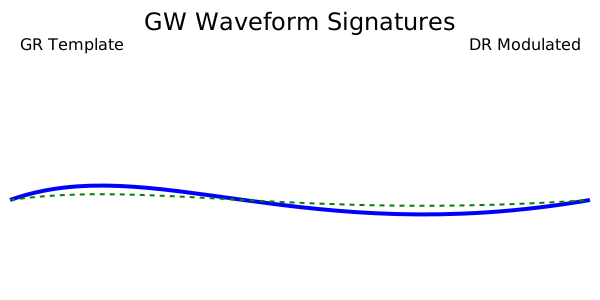
DR predicts subtle oscillatory modulations in gravitational wave waveforms, arising from Kaluza-Klein-like excitations in the compact dimensions. The observable is not a change in the overall chirp but a set of sidebands riding on it.
Equation 26.1 — Modulated Waveform
h(t) = hGR(t) × [ 1 + Σn εn cos(2πfnt + φn) ]
fn = n / Rc, Rc ≈ 10-18 m
yields sidebands in the kHz range | εn modulation depth per mode | φn mode phase
The protocol is a targeted reanalysis of existing binary merger events rather than a new instrument. Because the sidebands are coherent with the carrier, matched filtering against a modulated template bank recovers them at signal-to-noise well below the level at which they would appear in an unmodelled search. The kHz placement puts them in the band where detector sensitivity is already well characterized, so a null result sets a real upper bound on εn rather than an ambiguous one.
26.3 Resonance Protocol
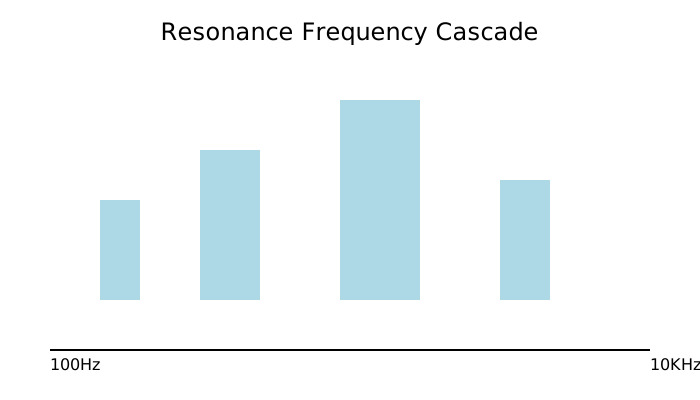
Precision acoustic and electromagnetic fields tuned to golden-ratio harmonics of the 11D metric frequencies are predicted to enhance coherence in structured matter. The frequency cascade is fully determined—there is no free parameter to tune after the fact.
Equation 26.2 — Golden-Ratio Frequency Cascade
fres = (φn / √5) × f0, n = 1, 2, 3 …
φ = (1 + √5)/2 | cascade spans 100 Hz to 10 kHz | f0 fixed by the 11D metric, not fitted
The falsifiable content is the spacing, not the effect. A response that peaks at arbitrary frequencies, or scales with applied power rather than with proximity to a cascade line, is indistinguishable from ordinary driven resonance in the apparatus and counts against DR. The protocol therefore requires the full cascade to be scanned, with off-line control frequencies interleaved and the operator blind to which is which.
Scope and Safety Constraint
The cascade prediction is a physical claim about coupling, not a validated therapeutic protocol. Any work involving biological systems belongs in bench and cell-culture assays first, under institutional review, with pre-registered endpoints and sham-exposure controls. No clinical claim is made or supported here, and none should be drawn from a positive coherence measurement alone.
26.4 Compact Dimension Leakage in Particle Colliders
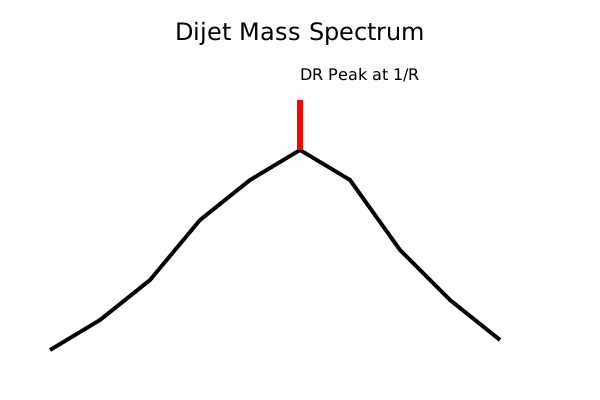
Excess dijet events are predicted at invariant masses corresponding to the 1/Rc scale. This is the cleanest of the four tests: the signal is a localized bump on a smooth, well-measured background, and its position is fixed by the same Rc that sets the gravitational wave sideband spacing.
The Standard Model dijet spectrum falls monotonically over orders of magnitude, so a resonance is detectable well below the level of any inclusive cross-section anomaly. Existing LHC datasets already cover the relevant mass range; the protocol is a dedicated search with the peak position fixed in advance by the GW analysis rather than floated as a fit parameter. A bump at a mass inconsistent with the GW-derived Rc would falsify the framework as decisively as no bump at all.
26.5 Cosmological Implications and Observables
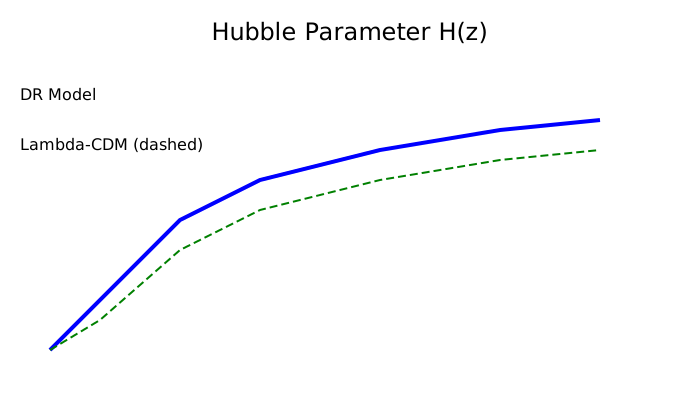
DR predicts a modified expansion history in the early universe, driven by extra-dimensional energy density. The deviation from ΛCDM grows with redshift, which is what makes it testable: at low z the two models are degenerate within current uncertainties, and the discriminating power sits at z ≳ 2 where the extra-dimensional contribution to H(z) becomes an appreciable fraction of the total.
The relevant observables are therefore high-redshift standard candles and rulers, quasar and Lyman-α measurements of the expansion rate, and the CMB-calibrated sound horizon. A DR signature appears as a coherent tilt in H(z) rather than a shift in a single parameter—which distinguishes it from the ordinary tensions in the low-redshift value of the Hubble constant, and means it cannot be absorbed by rescaling H0.
26.6 Conclusion and Next Steps
- One parameter, four channels: Rc ≈ 10-18 m fixes sideband spacing, resonance mass, and early expansion history simultaneously
- No new instruments required: three of the four tests are reanalyses of existing LIGO, LHC, and cosmological datasets
- Stated null results: absent sidebands, an off-mass bump, or a ΛCDM-consistent H(z) at high z each falsify the framework
- Cross-consistency as a test: the four channels measure the same Rc, so mutual disagreement falsifies DR even where individual signals appear
These protocols provide clear pathways for empirical validation or falsification of Dimensional Relativity. The immediate next step is not new theory but collaboration: targeted template-bank reanalysis with gravitational wave groups, a fixed-mass dijet search with collider collaborations, and bench-level resonance work under institutional review. Each can begin with data that already exists.